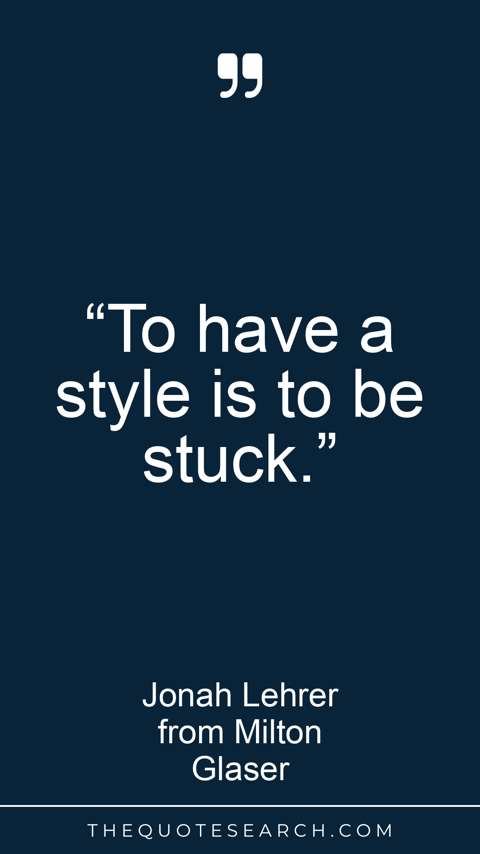
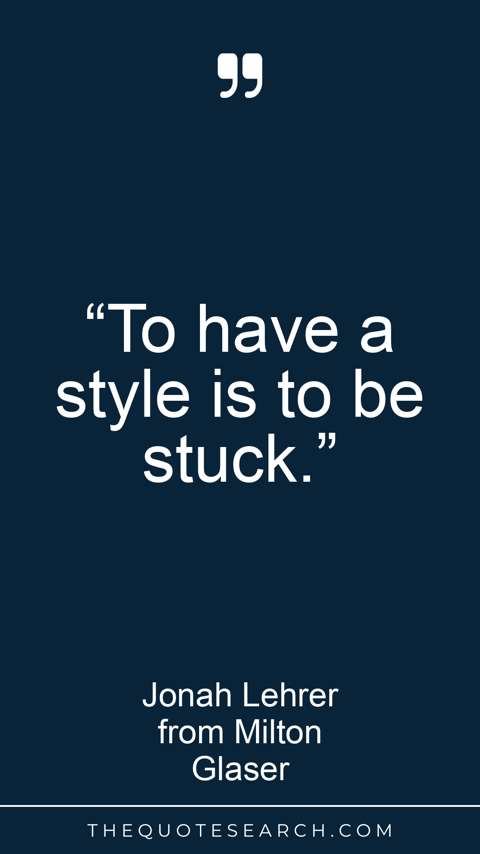
“To have a style is to be stuck.”

Explore This Quote Further
-
Working on it...
-
Working on it...
-
Working on it...
-
Working on it...
Similar quotes
“A few years ago, Tor Wager, a neuroscientist at Columbia University, wanted to figure out why placebos were so effective. His experiment was brutally straightforward: he gave college students electric shocks while they were stuck in an fMRI machine. (The subjects were well compensated, at least by undergraduate standards.)”
“We are all born with genius. It's like our fairy godmother. But what happens in life is that we stop listening to our inner voices, and we no longer have access to this extraordinary ability to create poetry.”
“We are the poem, his poem says, that emerges from the unity of the body and the mind. That fragile unity--this brief parenthesis of being--is all we have. Celebrate it.”
“Harlow would later write, "If monkeys have taught us anything, it's that you've got to learn how to love before you learn how to live.”
“...Why are corporations so fleeting?...Instead of imitating the freewheeling city, these businesses minimize the very interactions that lead to new ideas. They erect walls and establish hierarchies. They keep people from relaxing and having insights. They stifle conversations, discourage dissent, and suffocate social networks. Rather than maximizing employee creativity they become obsessed with minor efficiencies.”
“If you can sustain your interest in what you’re doing, you’re an extremely fortunate person. What you see very frequently in people’s professional lives, and perhaps in their emotional life as well, is that they lose interest in the third act. You sort of get tired, and indifferent, and, sometimes, defensive. And you kind of lose your capacity for astonishment — and that’s a great loss, because the world is a very astonishing place. What I feel fortunate about is that I’m still astonished, that things still amaze me. And I think that that’s the great benefit of being in the arts, where the possibility for learning never disappears, where you basically have to admit you never learn it.”