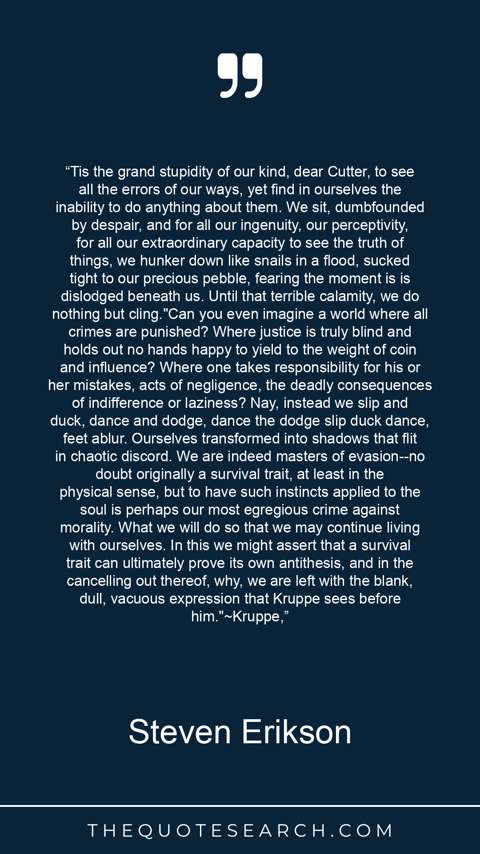
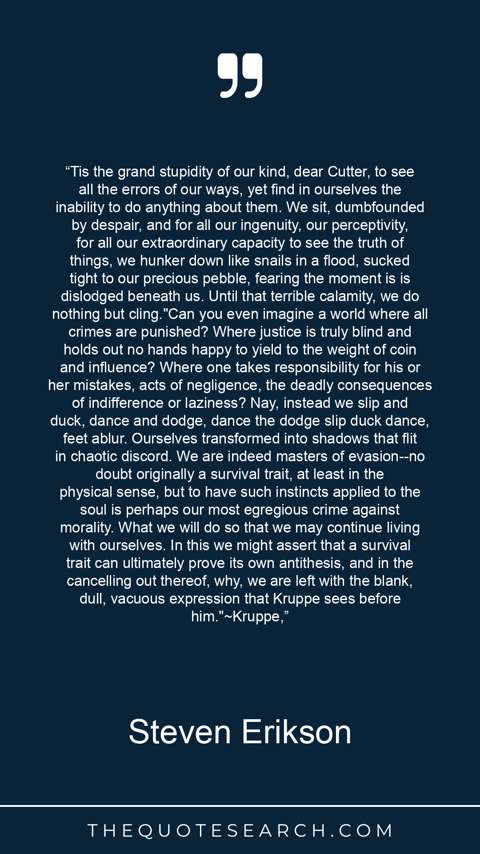
“Tis the grand stupidity of our kind, dear Cutter, to see all the errors of our ways, yet find in ourselves the inability to do anything about them. We sit, dumbfounded by despair, and for all our ingenuity, our perceptivity, for all our extraordinary capacity to see the truth of things, we hunker down like snails in a flood, sucked tight to our precious pebble, fearing the moment is is dislodged beneath us. Until that terrible calamity, we do nothing but cling."Can you even imagine a world where all crimes are punished? Where justice is truly blind and holds out no hands happy to yield to the weight of coin and influence? Where one takes responsibility for his or her mistakes, acts of negligence, the deadly consequences of indifference or laziness? Nay, instead we slip and duck, dance and dodge, dance the dodge slip duck dance, feet ablur. Ourselves transformed into shadows that flit in chaotic discord. We are indeed masters of evasion--no doubt originally a survival trait, at least in the physical sense, but to have such instincts applied to the soul is perhaps our most egregious crime against morality. What we will do so that we may continue living with ourselves. In this we might assert that a survival trait can ultimately prove its own antithesis, and in the cancelling out thereof, why, we are left with the blank, dull, vacuous expression that Kruppe sees before him."~Kruppe,”

Explore This Quote Further
-
Working on it...
-
Working on it...
-
Working on it...
-
Working on it...
Similar quotes
“There is something profoundly cynical, my friends, in the notion of paradise after death. The lure is evasion. The promise is excusative. One need not accept responsibility for the world as it is, and by extension, one need do nothing about it. To strive for change, for true goodness in this mortal world, one must acknowledge and accept, within one's own soul, that this mortal reality has purpose in itself, that its greatest value is not for us, but for our children and their children. To view life as but a quick passage alone a foul, tortured path – made foul and tortured by our own indifference – is to excuse all manner of misery and depravity, and to exact cruel punishment upon the innocent lives to come.I defy this notion of paradise beyond the gates of bone. If the soul truly survives the passage, then it behooves us – each of us, my friends – to nurture a faith in similitude: what awaits us is a reflection of what we leave behind, and in the squandering of our mortal existence, we surrender the opportunity to learn the ways of goodness, the practice of sympathy, empathy, compassion and healing – all passed by in our rush to arrive at a place of glory and beauty, a place we did not earn, and most certainly do not deserve.”
“[T]he unnamed soldier is a gift. The named soldier--dead, melted wax--demands a response among the living...a response no-one can make. Names are no comfort, they're a call to answer the unanswerable. Why did she die, not him? Why do the survivors remain anonymous--as if cursed--while the dead are revered? Why do we cling to what we lose while we ignore what we still hold? Name none of the fallen, for they stood in our place, and stand there still in each moment of our lives. Let my death hold no glory, and let me die forgotten and unknown. Let it not be said that I was one among the dead to accuse the living.”
“When we speak of ancient times, Rud Elalle, we find in our words things far nearer to hand, and all those emotions we imagined new, blazing with our youth, we find to be ancient beyond imagining.”
“There is nothing in the world which an artist cannot recreate into something poetic, ennobling. And why do we read these things? They are not facts, they do not improve our business skills, our techniques in manufacturing goods, the management of a home. That is what most of you will be doing anyway. We read these because they teach us about people, we can see ourselves in them, in their problems. And by seeing ourselves in them, we clarify ourselves, we explain ourselves to ourselves, so we can live with ourselves…”
“I believe that if, at the end of it all, according to our abilities, we have done something to make others a little happier, and something to make ourselves a little happier, that is about the best we can do. To make others less happy is a crime. To make ourselves unhappy is where all crime starts. We must try to contribute joy to the world. That is true no matter what our problems, our health, our circumstances. We must try.”
“When it comes to ourselves, we often have a blind spot. That is, we fail to see ourselves as others see us. We fail to recognize our most obvious traits: our strengths, weaknesses, mannerisms.”