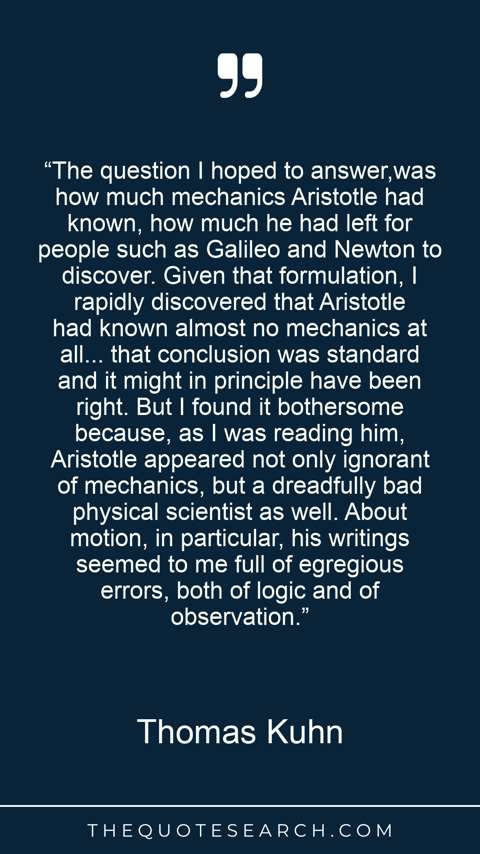
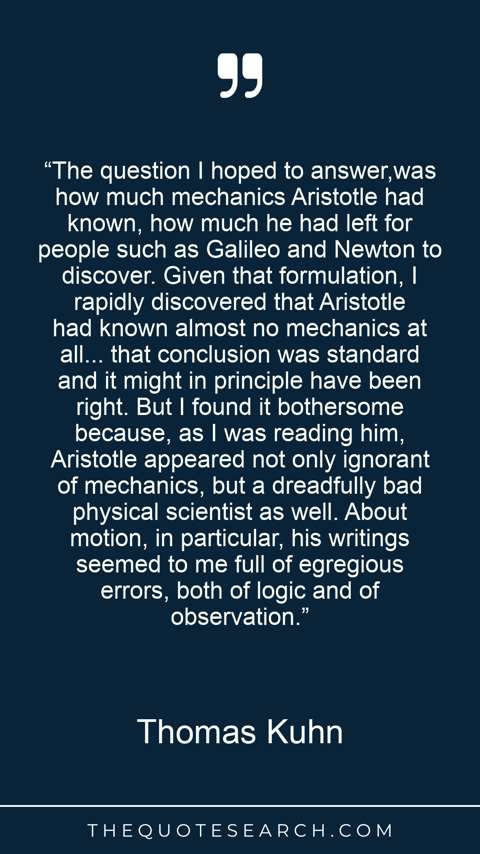
“The question I hoped to answer,was how much mechanics Aristotle had known, how much he had left for people such as Galileo and Newton to discover. Given that formulation, I rapidly discovered that Aristotle had known almost no mechanics at all... that conclusion was standard and it might in principle have been right. But I found it bothersome because, as I was reading him, Aristotle appeared not only ignorant of mechanics, but a dreadfully bad physical scientist as well. About motion, in particular, his writings seemed to me full of egregious errors, both of logic and of observation.”

Explore This Quote Further
-
Working on it...
-
Working on it...
-
Working on it...
-
Working on it...
Similar quotes
“Newton's three laws of motion are less a product of novel experiments than of the attempt to reinterpret well-known observations in terms of motions and interactions of primary neutral corpuscles”
“Once the question of grace and free will is reduced to a juridical matter, once witnesses line up with plaintiff or defendant and the jurors strive to determine who is entitled to what, we are inevitably tempted to act as if everything that was given to free will was taken from grace and everything conceded to grace was withdrawn from our own liberty.On both sides of the debate, whether one is arguing "for grace" or whether one is a defender of "nature," it seems that everyone is more or less obsessed with this great illusion of ownership and possession. What is strictly mine? How much can God demand of me - how much can I demand of Him? Even if I come up with the answer that nothing is strictly mine at all, I have still falsified the perspective by asking a foolish question in the first place. "How much is mine?" Should such a question ever be asked? Should such a division ever be made at all? To ask such a question makes it almost impossible for me to grasp the paradox which is the only possible answer: That everything is mine precisely because everything is His. If it were not His, it could never be mine. If it could not be mine, He would not even want it for Himself. And all that is His is His very self. All that He gives me becomes, in some way, my own self. What, then is mine? He is mine. And what is His? I am His.”
“Observation and experience can and must drastically restrict the range of admissible scientific belief, else there would be no science. But they cannot alone determine a particular body of such belief. An apparently arbitrary element, compounded of personal and historical accident, is always a formative ingredient of the beliefs espoused by a given scientific community at a given time”
“Normal science, the activity in which most scientists inevitably spend almost all their time, is predicated on the assumption that the scientific community knows what the world is like”
“Unable either to practice science without the Principia or to make that work conform to the corpuscular standards of the seventeenth century, scientists gradually accepted the view that gravity was indeed innate”
“When I first read Lovecraft around 1971, and even more so when I began to read about his life, I immediately knew that I wanted to write horror stories. I had read Arthur Machen before I read Lovecraft, and I didn’t have that reaction at all. It was what I sensed in Lovecraft’s works and what I learned about his myth as the “recluse of Providence” that made me think, “That’s for me!” I already had a grim view of existence, so there was no problem there. I was and am agoraphobic, so being reclusive was a snap. The only challenge was whether or not I could actually write horror stories. So I studied fiction writing and wrote every day for years and years until I started to get my stories accepted by small press magazines. I’m not comparing myself to Lovecraft as a person or as a writer, but the rough outline of his life gave me something to aspire to. I don’t know what would have become of me if I hadn’t discovered Lovecraft.”